 how-to
How to Prevent Budget Overruns on Bathroom Renovations
Last Updated: October 30, 2026
Quick Summary
To prevent budget overruns, track cost and schedule together every week using a budget-versus-actual report per phase, and recalculate your forecast at completion each time. Set variance thresholds before work starts so a number triggers action: green within 5% cost variance, amber between 5% and 10%, red above 10% or when forecast at completion exceeds the approved budget.
- A cost-loaded schedule assigns a planned dollar value to each phase so you can compare planned versus actual spend at milestones.
- Build a timeline backward from milestones, adding buffer days between phases for inspections and drying time.
- Keep contingency for genuine surprises only and require written approval for every withdrawal.
- Escalate when two or more warning signs appear at once or a change exceeds your remaining contingency.
- Hold a 15-minute weekly review asking three questions: cost variance, schedule variance, and forecast at completion.
Table of Contents
- Why Bathroom Renovations Overrun Budgets and How to Prevent Budget Overruns
- How to Choose a Bathroom Renovation Contractor Who Finishes on Time
- Building a Bathroom Renovation Project Timeline You Can Trust
- Your Bathroom Renovation Contract Checklist for Cost and Timeline Protection
- Setting a Bathroom Renovation Contingency Budget That Actually Covers Surprises
- Early-Warning Signs of a Budget Overrun and When to Escalate
- How to Prevent Budget Overruns with Tracking Tools and Time-and-Budget Control
- Request a Transparent Renovation Quote from CompleteBathrooms
- Frequently Asked Questions
Why Bathroom Renovations Overrun Budgets and How to Prevent Budget Overruns
A bathroom renovation rarely blows up in one dramatic moment. It leaks. A little more each week, until the final invoice lands well above the number you agreed to.
A budget overrun is the gap between your planned cost and your actual cost once the work is done. In plain terms, it is budget variance you did not see coming.
Most overruns start before a single tile is removed. Vague scope, optimistic estimates, and no contingency reserve all set the stage. Before committing, it helps to understand the real cost of a bathroom renovation.
Here is what we see most often:
- Scope creep, where small "while we're in there" additions pile up
- Allowances set too low for fixtures and finishes
- Hidden damage behind walls that nobody budgeted for
- Change orders signed without a clear price
- Deadlines that slip, which pushes labor costs higher
The good news: every one of these is preventable with the right planning.
How to Choose a Bathroom Renovation Contractor Who Finishes on Time
The best predictor of a project that finishes on time and within budget is the contractor you hire. Not the tile. Not the tub. The person running the job.
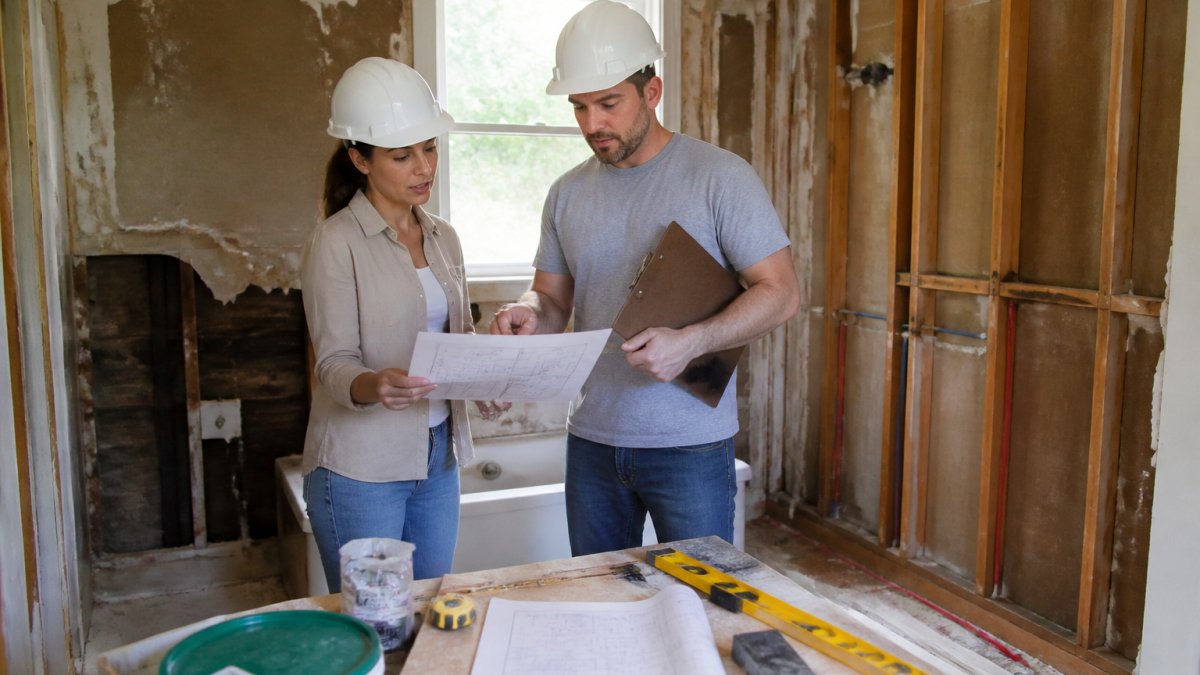
A useful vetting process goes beyond general questions.
1. Demand a schedule with named milestones and durations.
2. Ask for a cost-loaded schedule, not just a lump-sum quote.
This is the single question most homeowners never ask, and it is the one that exposes whether a contractor actually controls budget.
3. Test their change-order discipline.
Ask: 'Walk me through your last three change orders. Who approved them, what did they cost, and how did they affect the schedule?' A contractor with real controls will describe a written change-order process, scope description, price, schedule impact, written client approval before work proceeds. A contractor without controls will describe verbal agreements and 'we worked it out.' Unpriced change orders are one of the most common causes of budget overruns, and they are entirely preventable at the hiring stage.
4. Verify references against the schedule, not just the finish.
When you call references, do not ask 'were you happy?' Ask: 'Did the project finish on the date in the contract? How many change orders were there?
Red flags that predict overruns:
- A quote that is dramatically lower than every other bid, the thinnest contingency usually hides there
- No written schedule, or a schedule with no buffer days
- Reluctance to itemize labor versus materials
- Verbal change orders or 'we'll sort it out at the end'
- No named person managing the project day to day
A common mistake is choosing on price alone. The lowest bid often hides the thinnest contingency. Communication matters as much as craft.
Building a Bathroom Renovation Project Timeline You Can Trust
A realistic bathroom renovation project timeline is built backward from milestones, not guessed at the start. Projects typically move through demolition, rough-in, waterproofing, tiling, fixture install, and final finish. Each phase needs its own deadline.
Why does this matter for your budget? Because schedule delay costs money. Every extra week of labor, equipment, and disruption adds up.
Build your timeline like this:
- List every phase in order.
- Assign a milestone and date to each one.
- Add buffer days between phases for inspections and drying time.
- Agree on who signs off at each milestone.
- Review progress against the schedule every week.
Watch out: a schedule with zero buffer is a schedule that will slip. Waterproofing and curing take the time they take. Plan for it.
Your Bathroom Renovation Contract Checklist for Cost and Timeline Protection
A strong bathroom renovation contract checklist protects both your money and your time. Get these items in writing before work begins.
- Full project scope, room by room
- Itemized cost estimate, labor and materials split
- Payment schedule tied to milestones, not dates
- Change order process with written approval required
- Start date and completion date
- Contingency amount and how it gets used
- Warranty and post-project support terms
- Cleanup and disposal responsibilities
That last point matters more than people think. A tidy, communicative team keeps the job moving. A disorganized one loses days. For current prices or a quote tailored to your project, visit the CompleteBathrooms website before you finalize your budget.
Setting a Bathroom Renovation Contingency Budget That Actually Covers Surprises
A bathroom renovation contingency budget is money set aside for the unknowns, and it should be a real line item, not a vague hope. Older homes often hide surprises behind the walls.
How much should you hold back? The honest answer depends on the age and condition of your bathroom. A newer space needs less cushion than a decades-old one with original plumbing.
Treat your contingency as a reserve with rules:
- Set the amount before work starts
- Require written approval to draw on it
- Track every withdrawal
- Review what is left at each milestone
Watch out: a contingency you dip into for upgrades is not a contingency. It is a slush fund. Keep it for genuine surprises only.
Early-Warning Signs of a Budget Overrun and When to Escalate
Most overruns announce themselves before they land. The trick is knowing what to watch for and acting early.
Here are the early-warning indicators we flag:
- Repeated small change orders adding up
- A phase running past its milestone date
- Vague answers about cost forecasting
- Material substitutions without discussion
- Allowances quietly running out
- Fewer progress updates than agreed
So when do you escalate? When two or more of these appear at once, or when any single change pushes you past your remaining contingency. Escalation means a direct conversation, a written summary of where the budget stands, and a corrective action plan.
This is where governance matters. Agree upfront who has decision rights on changes. Clear accountability stops small problems from becoming expensive ones.
How to Prevent Budget Overruns with Tracking Tools and Time-and-Budget Control
The most reliable way to prevent budget overruns is to track cost and schedule together, every week. Applying this integrated tracking method to other complex projects remains the most effective strategy for avoiding renovation budget overruns when managing larger spaces like kitchens.
You do not need complex software. A simple tracking sheet works, but it has to contain the right columns and trigger the right actions.
The weekly budget-versus-actual report.
Build one row per phase (demolition, rough-in, waterproofing, tiling, fixture install, final finish) with these columns:
- Planned cost to date
- Actual cost to date
- Cost variance (actual minus planned)
- Planned completion date for the phase
- Actual or forecast completion date
- Schedule variance (days ahead or behind)
- Remaining contingency
- Forecast at completion (FAC)
Forecast at completion is the number that matters most.
Set variance thresholds in advance.
A threshold turns a number into an action. Agree on these before work starts:
- Green: cost variance within 5% of planned and schedule variance within 3 working days. Continue normal weekly review.
- Amber: cost variance between 5% and 10%, or schedule variance between 3 and 7 working days. Project lead reviews the cause, documents it, and proposes a corrective action at the next weekly meeting.
- Red: cost variance above 10%, schedule variance above 7 working days, or FAC exceeding the approved budget. Escalate immediately, written summary of where the budget stands, a corrective action plan, and a decision on whether to draw on contingency or revise scope.
These thresholds are illustrative; the exact percentages should reflect the size and risk of your project.
A worked example.
Suppose the approved budget is $30,000 with a $3,000 contingency (10%).
A contingency you dip into for upgrades is not a contingency. It is a slush fund. Keep it for genuine surprises only, and require written approval for every withdrawal.
Escalation rules and decision rights.
Tracking only works if someone acts on the numbers. Agree upfront who has authority to:
- Approve a change order and at what dollar value
- Authorize a contingency draw
- Revise the forecast at completion
- Approve a schedule recovery plan
Review cadence.
Hold a 15-minute weekly review with your contractor using the report above. Compare progress monitoring notes to the original plan.
A common pitfall is waiting for the final invoice to find out how the budget performed. By then, corrective action is limited.
Agree these variance thresholds before work starts so a number triggers an action instead of a judgment call.
| Status | Cost variance | Schedule variance | Action |
|---|---|---|---|
| Green | Within 5% of planned | Within 3 working days | Continue normal weekly review |
| Amber | Between 5% and 10% | Between 3 and 7 working days | Project lead reviews cause and proposes corrective action |
| Red | Above 10% | Above 7 working days | Escalate immediately with written summary and corrective plan |
| Red | FAC exceeds approved budget | Any | Escalate immediately with written summary and corrective plan |
Request a Transparent Renovation Quote from CompleteBathrooms
A renovation that finishes on time and within budget depends on planning, clear scope, a real contingency, and weekly tracking.
CompleteBathrooms provides detailed quotes with clear cost and timeline transparency, so you know what you are paying for before work starts. The team specializes in aging-in-place bathroom solutions and custom designs for compact, challenging spaces.
If surprise costs and slipping deadlines are what you want to avoid, start with a clear quote.
Get started with CompleteBathrooms and renovate with confidence and clarity.
Frequently Asked Questions
How do you ensure a bathroom renovation is completed on time and within budget?
Start with a detailed written scope and a contract that lists what is and isn't included. Ask for a milestone-based schedule so you can track progress week by week. Hold a contingency reserve of 10 to 15 percent of the project cost for hidden issues like water damage or outdated wiring. Review actual costs against planned costs at each milestone, and require written change orders before any extra work begins. This is how you prevent budget overruns instead of reacting to them.
What should a bathroom renovation budget include to prevent cost overruns?
A complete budget covers labor, materials, fixtures, permits, disposal fees, and taxes, plus a contingency line. It should also account for temporary bathroom arrangements and any work needed to bring plumbing or electrical up to current code. Ask your contractor for a line-item quote rather than a lump sum so you can see where money goes. Pricing varies by scope and site conditions, so request a written quote for your specific project rather than relying on general estimates.
How should a homeowner handle unexpected costs during a bathroom renovation?
Stop work on the affected item and get the issue documented in writing, with photos and a cost breakdown. Compare the new cost against your contingency budget before approving it. If the total exceeds your reserve, decide which non-essential items to defer rather than borrowing more. A contract clause that requires written approval for any change order protects you here. Contractors who communicate early and put changes in writing are far easier to work with when surprises appear.
How can you tell whether a bathroom contractor has a track record of finishing on time and on budget?
Ask for references from projects similar in size and layout to yours, and call them. Ask specifically whether the project finished on schedule and whether the final invoice matched the quote. Request photos of completed bathrooms, including small or awkward spaces. A contractor who provides a detailed written quote, a milestone schedule, and a clear change-order process is showing you their system for staying on budget. Vague answers about timelines are a warning sign.
Ready to plan a bathroom that stays on budget? Reach out to our team for a detailed, transparent quote and a timeline you can count on.