 ultimate-guide
One Piece Bathtub and Surround: What to Know Before You Buy
Last Updated: November 12, 2026
Quick Summary
A one piece bathtub and surround is a single molded unit combining the tub, wall surround, and often the shower receptor, so there are no seams for water to get behind the wall. Before buying, confirm the rough opening dimensions, drain orientation, and that the unit physically fits through every doorway and hallway on the delivery path.
- A one piece bathtub and surround often needs 80 centimetres or more of clear width to pass through a doorway.
- Acrylic is thicker and non-porous, while fiberglass is lighter and cheaper but its gel coat can dull and crack.
- Measure the finished opening at the back wall, front edge, and floor, and record the smallest number for each.
- A left-hand drain sits on the left as you face the tub; a right-hand drain sits on the right.
- Ask whether a quote includes removal and disposal, subfloor repair, drain rerouting, valve replacement, and finish patching.
Table of Contents
- Why a One Piece Bathtub and Surround Changes the Renovation
- Tub and Shower Combo Dimensions and Drain Orientation
- How to Measure for a New Bathtub Before You Order
- Acrylic vs. Fiberglass: Which Surround Material Holds Up
- Best Low Maintenance Bathroom Materials for Cottages
- Structural Clearance and Delivery: Getting a One-Piece Unit Inside
- Bathtub and Shower Combo Installation Cost: What Drives the Quote
- Book a Bathroom Assessment with CompleteBathrooms
- Frequently Asked Questions
Why a One Piece Bathtub and Surround Changes the Renovation
A one piece bathtub and surround is a single molded unit that combines the tub, the wall surround, and often the shower receptor into one seamless piece. The appeal of these units is simple: no seams means no place for water to get behind the wall.
The difference shows up years later. A multi-piece setup relies on caulking and a flange to keep water out. Caulk cracks. Flanges get misaligned during a rushed install. A one piece bathtub and surround removes those failure points because there is nothing to join together.
That said, this is not a universal upgrade. The same single-piece construction that makes it leak-proof also makes it heavy, awkward, and unforgiving of a mismeasured bathroom. Below, we break down what actually matters before you commit to a one piece bathtub and surround, from dimensions and drain orientation to the delivery problem most guides skip entirely.
One-Piece vs. Multi-Piece: The Trade-Off Nobody Explains
Most buying guides frame this as a simple quality question. It is really a logistics question.
A multi-piece tub and shower combo arrives in sections you can carry through a standard doorway. A one piece bathtub and surround arrives as one solid object, often 1.5 metres wide or more, and it has to physically fit through every door, hallway turn, and stairwell between your front entrance and the bathroom. If it does not fit, the unit does not go in, full stop.
The trade-off breaks down like this:
| Factor | One-Piece Unit | Multi-Piece Unit |
|---|---|---|
| Leak risk | Low, no seams | Higher, depends on caulking |
| Installation time | Faster once inside | Slower, more assembly steps |
| Delivery access | Hard, needs clearance check | Easy, fits standard doors |
| Repair | Harder, whole unit affected | Easier, replace one section |
| Best for | Straightforward access, long-term durability | Tight hallways, upstairs bathrooms |
If you are weighing whether to remodel your existing shower or replace it outright, our guide on whether to remodel or replace your shower walks through that decision in more depth.
Tub and Shower Combo Dimensions and Drain Orientation
Standard alcove tub and shower combos come in a range of sizes, so the numbers that matter are the ones for the specific unit you are considering.
The dimensions that actually decide whether a unit fits are not the marketing dimensions on the spec sheet.
Drain orientation is the detail buyers overlook most often. A left-hand drain sits on the left as you face the tub; a right-hand drain sits on the right.
The drain rough-in matters as much as the side. Measure from the finished wall to the centre of the drain opening, and from the side wall to the centre.
Depth matters too. A deeper soaker tub feels better but raises the step-over height, which is a real consideration for aging-in-place modifications.
If space planning is the sticking point, our small bathroom layout planning guide covers how to confirm a unit will actually fit before you buy.
How to Measure for a New Bathtub Before You Order
Measure the finished opening, not the old tub. Use a tape measure at the back wall, the front edge, and the floor, and write down the smallest number for each dimension. Walls are rarely square, and a one piece bathtub and surround needs the rough opening to be accurate within a small tolerance.
Follow this sequence:
- Measure the alcove length from stud to stud at the back wall.
- Measure the width from the finished wall to the front opening.
- Measure the height clearance from the subfloor to any obstruction above.
- Note the drain location and measure its distance from each wall.
- Check the doorway and hallway path the unit must travel.
If space planning is the sticking point, our small bathroom layout planning guide covers how to confirm a unit will actually fit before you buy.
Acrylic vs. Fiberglass: Which Surround Material Holds Up
Acrylic and fiberglass are the two common materials for a one piece bathtub and surround. Acrylic is a thicker, denser material with a high-gloss finish. Fiberglass is lighter and often cheaper, but the gel coat can dull and crack with age.
Acrylic also cleans more easily because the surface is non-porous. Fiberglass, once the gel coat wears, can stain and hold onto soap scum.
Both materials benefit from a molded-in storage shelf and integrated shelves, which keep shampoo and soap off the tub deck and reduce clutter. Look for a unit with molded-in storage rather than add-on shelves, since add-on versions collect water and mildew behind them.
Best Low Maintenance Bathroom Materials for Cottages
Cottage bathrooms face harder conditions than a primary home: seasonal use, humidity swings, and sometimes unheated periods. The best low maintenance bathroom materials for cottages are non-porous and seam-free, which is exactly why a one piece bathtub and surround suits a cottage so well.
Acrylic units resist moisture. A smooth, high-gloss surface wipes clean. Pair the unit with a waterproof wall surround and sealed subfloor to reduce water behind the walls and standing moisture in seams.
For cottages that sit empty through winter, avoid materials that trap water in joints. A seamless design with proper caulking at the wall-to-floor line, checked each spring, will outlast a tiled shower with grout lines that crack in the cold.
Structural Clearance and Delivery: Getting a One-Piece Unit Inside
This is the part most guides leave out entirely. Before you buy a one piece bathtub and surround, walk the delivery path yourself with a tape measure. Measure every doorway width, every hallway turn, and the stairwell clearance if the bathroom is upstairs.
A one piece bathtub and surround often needs 80 centimetres or more of clear width to pass through a doorway, and it needs room to tilt and turn at corners.
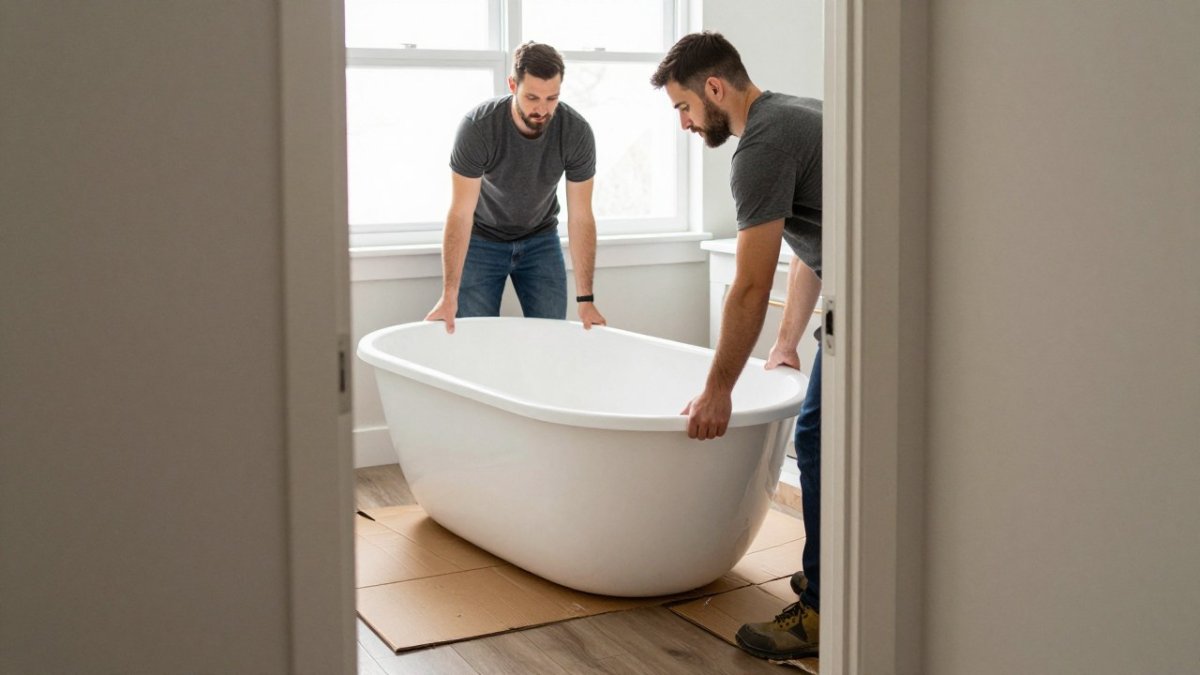
Check this clearance before the order is placed, not on delivery day, since discovering an access problem later can turn a straightforward replacement into an expensive workaround.
Bathtub and Shower Combo Installation Cost: What Drives the Quote
Installation cost for a one piece bathtub and surround depends on the access path, the condition of the subfloor and plumbing rough-in, and whether the drain needs rerouting. Reviewing these bathroom remodel plumbing cost tips helps clarify how specific site conditions influence the final estimate.
Pricing depends on the access path, the condition of the plumbing and subfloor, and the finish work involved, so the only reliable figure is one based on your bathroom. Contact CompleteBathrooms through the website for a quote.
What drives the quote up or down:
- Access: A ground-floor bathroom with a wide hallway is simpler than an upstairs unit that has to come through a window. Window entry adds labor for removal and refitting of the window, plus protection and often a temporary hoist or extra hands. A tight hallway turn that requires removing a door frame or a section of drywall adds carpentry and patching to the bill.
- Plumbing condition: Old or misaligned rough-in adds labor. A right-hand drain where you need a left-hand drain means rerouting the drain line, which means opening the floor or the wall below, new fittings, and a re-inspection. Galvanized or polybutylene supply lines discovered during demolition are a separate line item.
- Subfloor and waterproofing: Rotted subfloor or missing waterproofing must be corrected before the unit goes in. Soft spots around the drain and along the tub apron are common in older homes, and replacing a section of subfloor plus adding a waterproof membrane is labor and material the original quote may not include.
- Removal and disposal: Taking out the old tub and surround, and hauling it away, is part of the job. A cast-iron tub is far heavier and slower to remove than a steel or acrylic one, and disposal fees vary by municipality.
- Finish work: Tiling the surround above the unit, replacing the valve and trim, and patching and painting the walls around the alcove are finish items that are easy to leave off a quote and expensive to add later.
The best way to avoid surprise costs is a detailed, written quote that lists what is included and what is not. Ask specifically whether the quote includes removal and disposal, subfloor repair, drain rerouting, valve replacement, and finish patching.
Our articles on avoiding hidden renovation costs and preventing budget overruns explain how to read a quote so nothing catches you off guard, and our local renovation cost breakdown gives context for the quote you receive.
Book a Bathroom Assessment with CompleteBathrooms
The right one piece bathtub and surround comes down to three checks: accurate measurements, correct drain orientation, and a delivery path that actually works. Miss any one of them and a simple replacement becomes a costly project.
At CompleteBathrooms, the owner handles the work personally from demolition through to completion. We keep you informed throughout the project, offer options when an issue comes up, and design functional layouts for compact or awkward spaces.
Get started with CompleteBathrooms and book a bathroom assessment so we can confirm your measurements, check the access path, and give you a clear, transparent quote before any work begins.
A bathroom that fits properly from day one saves you from leaks, callbacks, and rework later. CompleteBathrooms brings hands-on installation, honest quotes, and clear communication to every project, from a straightforward tub replacement to a full aging-in-place modification.
Frequently Asked Questions
Can a one-piece tub and shower fit through standard bathroom doors?
Often it cannot, and that is the detail buyers miss. A one-piece bathtub and surround is molded as a single unit, so it has to pass through every doorway, stairwell, and hallway turn on the way in. Measure the narrowest opening and the tightest corner before ordering. In many homes the unit goes in before the bathroom doorway is framed, or through a window opening. A contractor who has done this before will check the path first and tell you honestly whether it will fit.
Are one-piece bathtub surrounds durable?
A quality acrylic one-piece unit holds up well because there are no seams for water to work into. The weak points are the base and the caulking line where the surround meets the floor or drywall, so a solid subfloor and proper waterproofing behind the flange matter more than the material name on the box. Fiberglass costs less but flexes more and can crack under heavy use. With correct installation, either type can last many years; poor installation shortens the life of both.
How does a one-piece unit compare to a tiled shower surround?
Tile looks custom and lets you match any color scheme, but it brings grout lines that need scrubbing and resealing, plus a higher labor bill. A one-piece surround installs faster, wipes clean with a cloth, and has no grout to stain. The trade-off is fewer design choices and the delivery challenge of getting a large molded unit inside. For a cottage or a rental where low upkeep matters, the one-piece usually wins; for a statement bathroom, tile still has the edge.
What is the average cost of installing a one-piece tub and shower?
Pricing depends on the unit size, material, drain orientation, and what has to be removed or rebuilt underneath, so contact CompleteBathrooms through the website for a quote. A straight swap over sound plumbing costs far less than a job that needs a new subfloor, moved drain, or updated valve. At CompleteBathrooms we give a detailed written quote with the cost and timeline spelled out before work starts. Book an assessment for a figure based on your actual bathroom.